









Shop For INR 28,000 & above & Get Flat INR 2200 Off
Code: SHOPMORE28K





 Speak to our stylist
Chat with us on +919773983391
 Loyalty Rewards
Cart
Shop For INR 28,000 & above & Get Flat INR 2200 Off
Shop For INR 45,000 & above & Get Flat INR 4200 Off
Shop For INR 1,20,000 & above & Get Flat INR 10,000 Off
Shop For INR 1,75,000 & above & Get Flat INR 12,000 Off
 Free Shipping Across India
 100% Pure Fabric
 COD Available
 Delivering Worldwide
Your cart is empty
Indian textiles and crafts have a rich legacy just like the land itself. There is a particular kind of beauty that comes from constraint. Bandhani or Bandhej from Rajasthan is a story of beauty in constraint. The craft is built on the premise that if you take a piece of fabric and refuse to let certain parts of it receive color - if you protect them, deliberately, with a knot - what you get when the knots come off is something more alive than any printed surface could ever produce.
Every dot on a Bandhani fabric is a decision. The decision of the skilled artisan. A visualization that cannot happen on pen and paper.
A tiny pinch of cloth, gathered between the fingernails, bound with thread so tightly that no dye can reach it. Thousands of these decisions, made in sequence, by hands that know exactly what the finished pattern will look like even when the fabric is still entirely tied and completely unrecognisable.
This knowledge - the ability to see the finished piece inside the bound one - is the craft we know as Bandhani or Bandhej. Everything else is just thread and dye.

Shop: Noora - Rani Hotpink Short Kurta With Salwar
Bandhani is one of the oldest textile traditions in India. References to tie-dyed cloth appear in historical texts dating back over a thousand years, and the craft has been practiced continuously in Rajasthan and Gujarat since at least the 12th century.
The name Bandhani comes from the Sanskrit word bandhan - to bind. It is also known as Bandhej in Gujarat, where the craft has its most elaborate and celebrated history.
The Khatri community of Rajasthan and Gujarat is the primary custodian of the Bandhani tradition. For generations, the knowledge of pattern, dye sequence, and tying technique has been passed within their families. From grandmother to mother to daughter, from grandfather to father and to son - each generation learnt the craft through observation and practice.
Today, Bandhani craft clusters are scattered across Jamnagar, Bhuj, Kutch, in Gujarat, and Jodhpur and Jaipur in Rajasthan.
Jamnagari Bandhani from Gujarat holds a GI tag - a legal acknowledgement that the craft belongs to a specific geography and a specific community, and cannot be authentically replicated elsewhere.
This matters more than it might seem.
The water of Kutch, the dyes used by specific artisan families, the particular knot pressure that comes from years of practice in a specific tradition - these are not variables you can relocate to a factory.
Bandhani is not a textile, it is not a print, it is not an embroidery. Bandhej or Bandhani is a craft practiced on fabric.
Traditionally, Bandhani is done on cotton or silk. Though in recent times, modal and georgette are also used in contemporary Bandhani work.
The cloth is first washed and prepared to receive natural dyes by treating it with substances that help the colour bond with the fibre.
Then the tying begins.
The artisan draws a pattern onto the fabric - or works entirely from memory for patterns that have been made so many times they no longer need to be marked.
Using their fingers, they gather tiny pinches of fabric at each point where an undyed dot should appear, and wind thread around each pinch tightly enough to prevent any dye from penetrating.
After tying, the cloth goes into the dye bath.
For multi-coloured Bandhani, the sequence matters enormously - lightest colors first, darkest last, with additional tying happening between dye baths to protect colours already achieved.
A deep red and white Bandhani requires the white dots to be tied before the red dye bath. A three-color Bandhani requires careful choreography of tying, dyeing, partial untying, re-tying, and dyeing again.
When the final dye bath is complete, the threads come off. The fabric is opened. The pattern appears.

Shop: Shezia - Orange Long Chauga With Salwar
A single dupatta might have 10,000 to 20,000 individual tie points. Large, elaborate Bandhani work - the kind made for bridal occasions - can carry 75,000 or more.
This is not a step that can be mechanised without losing the essential quality of Bandhani.
Machine-made imitations produce flat, uniform dots on a printed surface. Genuine Bandhani dots have a slightly raised quality. This is not a defect. It is how you identify the real thing.
Bandhani is, in fact, not purely decorative. The patterns in traditional Bandhani carry specific significance. Certain designs are associated with specific occasions, communities, and stages of life, and it all originates from the land where it is practiced.
The most common Bandhani pattern is the simple dot - leheriya dots in diagonal lines, or shikargah in scattered arrangements.
The Ekdali is a single central dot.
The Trikunti is a triangular arrangement of three dots.
The Chaubundi is four dots at the corners of a square.
These names and arrangements are not arbitrary - they are a visual language developed over centuries, where the placement of dots tells you something about the occasion and community the fabric was made for.
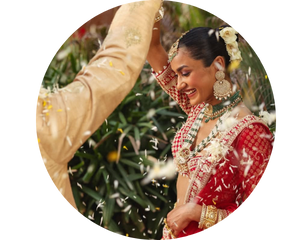
Brides in Rajasthan and Gujarat often choose to wear Bandhani Lehengas or Bandhani sarees on their wedding day. Bridal Bandhani typically carries the most elaborate patterns.
The Gharchola, a specific type of Bandhani saree traditionally gifted to a bride, features gold zari woven into a checked pattern with Bandhani dots in each square. It is worn for the first time at the wedding ceremony and is one of the most visually distinctive garments in Indian textile tradition.
 Shop: Esra - Heirloom Mustard Long Chauga With Salwar
At Sheetal Batra, Bandhani appears across suit sets, kurtas and shararas - and in each application the craft is understood for what it is rather than used as surface decoration. We celebrate Indian traditions and Indian craftsmanship.
The Bandhani pieces in our Bandhani collection are blended with silhouettes and embroidery traditions that Sheetal Batra has spent over two decades working with.
Each piece is made to order, tailored to your measurements, and delivered with the brand's signature attention to presentation. Dry clean to preserve the colour and the integrity of the tied dots.

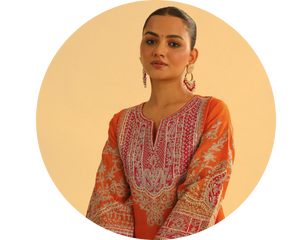
Shop: Hoorain - Orange Kurta With Sharara And Dupatta
Indian fashion has a long relationship with the idea of what is authentic and what is not. Digital prints that copy block print patterns, screen printing that approximates natural dye effects, or flat printed dots sold as Bandhani - the imitations are everywhere, and they have been for decades.
Bandhani endures not despite this but partly because of it. Genuine bandhani comes with its own story, the story of being hand-tied, the story of visualization by the artisan, the story of being dyed by hand.
The craft survives because it produces something that cannot be produced any other way. Explore authentic Bandhani suits and ethnic wear with exquisite embroidery by Sheetal Batra.