











Shop For INR 28,000 & above & Get Flat INR 2200 Off
Code: SHOPMORE28K





 Speak to our stylist
Chat with us on +919773983391
 Loyalty Rewards
Cart
Shop For INR 28,000 & above & Get Flat INR 2200 Off
Shop For INR 45,000 & above & Get Flat INR 4200 Off
Shop For INR 1,20,000 & above & Get Flat INR 10,000 Off
Shop For INR 1,75,000 & above & Get Flat INR 12,000 Off
 Free Shipping Across India
 100% Pure Fabric
 COD Available
 Delivering Worldwide
Your cart is empty
There is a quality that the finest Indian embroidery shares with the finest Indian architecture. Both refuse to be hurried, and both accumulate detail in a way that reveals itself slowly. First the overall impression, then the specific motif, then the individual stitch, and finally the understanding that what you are looking at took a very long time to exist. Dabka Zardozi is that kind of embroidery - Royal and Magnanimous. It does not give itself to you all at once. Dabka Zardozi asks you to look and marvel.
To understand Dabka Zardozi, you have to start with Zardozi itself. Dabka is a specific form of the broader embroidery tradition, and this tradition is one of the most significant embroidery lineages in the world.
The word Zardozi comes from Persian - zar meaning gold, dozi meaning embroidery. It is, literally, the embroidery of gold.
The technique of Zardozi traveled to India during the Mughal court in the 16th century, arriving from Persia and Central Asia with artisans who had spent generations developing a craft of extraordinary technical complexity. The Mughal emperors, who had both the wealth and the aesthetic appetite to commission work at this level, established Zardozi as the ‘embroidery of the court '.
Tents, tapestries, saddle cloths, garments, elephant trappings - all were embellished with the dense metalwork that Zardozi's finest practitioners could produce.
The craft found its deepest roots in Lucknow, where Nawabi patronage sustained it through centuries of political change.
Delhi, Agra, Hyderabad, and later Mumbai also developed significant Zardozi traditions. Each region developed its regional variations in technique and aesthetic, but all shared the fundamental character of the craft: the use of metallic thread, wire, and embellishments built up from the surface of fabric to create three-dimensional, lustrous embroidery of exceptional richness.

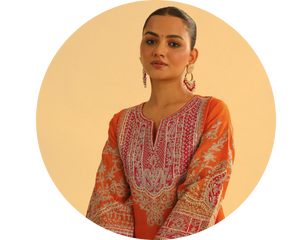
Shop Now: Shaheen - Daisy Ivory Hand Embroidered Short Choga With Salwar
Traditional Zardozi uses gold and silver wire, metallic threads, sequins, pearls, and precious or semi-precious stones.
In its historical form, the metalwork was genuinely precious - real gold wire on silk, worked by master craftsmen whose output was measured not in pieces but in years.
Contemporary Zardozi uses high-quality metallic threads and materials rather than actual gold and silver, which makes the craft accessible without diminishing the skill it requires.
The technique is worked on a taut frame called the adda. The fabric is stretched across a wooden frame, and the artisan works from above using aari needles and various tools to couch metallic threads, insert bullion coils, and build the surface embellishment layer by layer.
The embroidery is always done on the surface of the fabric. Zardozi adds to the cloth rather than working through it, which is what creates the characteristic three-dimensional quality of the finished embroidery.
Within the Zardozi tradition, different materials and threads create different effects.
Bullion is a tightly coiled metallic wire that creates a textured surface. Flat metallic thread creates smooth areas of colour, whereas sequins and shisha mirror work add reflective detail.
And Dabka, a fine, smooth metallic wire, creates the clean outlines and filled areas that give Dabka Zardozi its distinctive character.
Dabka is, in fact, a pliable metallic wire, smoother and more linear than bullion. It can be couched along the fabric surface in continuous lines or used to fill areas of a motif with parallel runs of wire that create a characteristic rippled texture.
When worked in dense parallel lines, Dabka creates a surface that reads almost like fine metalwork. The whole surface becomes a continuous metallic field that looks stunning and becomes the centre of attraction.

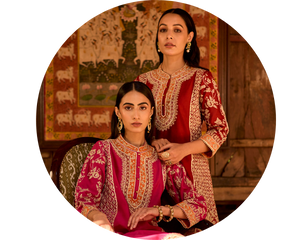
Shop Now: Rua - Deep Red Long A-line Kurta With Palazzo
The process of Dabka Zardozi begins with a design transfer. The motifs - floral, paisley and more - are traced onto the fabric directly. Sometimes the artisan works from a long-memorised pattern achieved from years of practice and precision,
The frame adda is set up, and the fabric is stretched taut.
The artisan works from above, holding the Dabka wire in one hand and a needle in the other, couching the wire along the design lines with small securing stitches placed at regular intervals.
The tension on the wire and the spacing of the securing stitches determine whether the Dabka lies flat and smooth or develops the slightly ridged quality that characterises finely worked pieces.
Bullion coils and French knots are added in separate stages, each requiring different tools and techniques.
The French knot is the most delicate element - a single wrap of thread around the needle, pulled through at the precise point of entry, creating a tiny raised knot that, in dense clusters, produces a surface of extraordinary tactile and visual richness.
A heavily embroidered Dabka Zardozi outfit like a bridal lehenga with full surface coverage, or a suit set with dense border work, can take several hundred hours to complete.
The Sanaa bridal lehenga at Sheetal Batra carries 800 hours of Dabka Zardozi work. The Mahanoor carries 890. These numbers are not marketing - they are the simple arithmetic of what the craft actually requires.

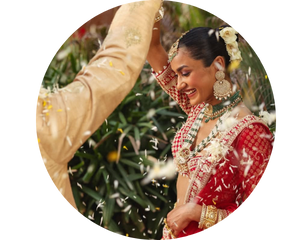
Shop Now: Sanaa - Dabka Zardozi Embroidered Raw Silk Red Bridal Lehenga Set
At Sheetal Batra, Dabka Zardozi is treated not as embellishment applied to a garment but as the primary reason the garment exists.
The fabric is chosen to support the embroidery. Our zardozi embroidery is often done on pure raw silk. This fabric is chosen for its structural integrity and natural texture, which allows Dabka wire to sit flush against the surface without puckering.
You can also find Dabka zardozi work on Silk Chanderi, known for its luminosity, which complements the metallic surface of dense Dabka work.
The motifs used in Sheetal Batra's Dabka Zardozi pieces draw from the Mughal floral vocabulary that the tradition was built on - grand paisleys, botanical forms, geometric borders with intricate interior details. Applied with the scale and density that contemporary bridal and occasion dressing demands. These are not small accent details. They are full-surface embroidery that covers the lehenga, the blouse, the borders of the dupatta - creating outfits where every square inch of visible fabric has been considered and worked by hand.
Every Sheetal Batra piece carrying Dabka Zardozi embroidery and priced above ₹50,000 comes with the brand's Heritage and Trust Certification - a digital certificate of craft authenticity confirming the embroidery technique, the fabric, and the man-hours involved. Bridal pieces are covered by unlimited complimentary repairs for three years.
This is not a warranty in the commercial sense. It is a recognition that a garment made with several hundred hours of handcraft deserves the institutional commitment to last far beyond the occasion it was made for.
Dabka Zardozi endures because it produces something that cannot be produced any other way. The wire sits on the fabric because a person placed it there, one run at a time, across hundreds of hours. The motif reads as a motif because someone who understood the tradition decided where it should be and how it should be built. The designer outfit holds its surface because the securing stitches were placed with enough care to last.
That is not a quality you can print. It is not a quality you can machine. It is the quality of time, applied with skill, in service of something worth making.
At Sheetal Batra, that is the only standard to which the embroidery is held.