










Shop For INR 28,000 & above & Get Flat INR 2200 Off
Code: SHOPMORE28K





 Speak to our stylist
Chat with us on +919773983391
 Loyalty Rewards
Cart
Shop For INR 28,000 & above & Get Flat INR 2200 Off
Shop For INR 45,000 & above & Get Flat INR 4200 Off
Shop For INR 1,20,000 & above & Get Flat INR 10,000 Off
Shop For INR 1,75,000 & above & Get Flat INR 12,000 Off
 Free Shipping Across India
 100% Pure Fabric
 COD Available
 Delivering Worldwide
Your cart is empty
Multiple embroideries in India are popular and known for their heavy, majestic look - zari-heavy zardozi, the dense metallic shimmer of Kashmiri Tilla, and the shiny elegance of sitaara. Then there is kirandori embroidery - a quieter one of the lost yet more mesmerising in that quiet elegance. It's an embroidery technique that radiates light, not overwhelmingly, but in the particular way that a glass of water catches sunlight.
Kirandori embroidery is luminous and surprises you every time you look at it from a different angle. Sheetal Batra shares with you insights about this mesmerising embroidery from Madhya Pradesh.

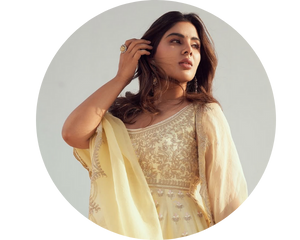
Shop Now: Aamna Shariff In Mysha - Deep Blue Long Choga With Salwar
The name tells you everything you need to know about the technique's essential quality. Kiran in Hindi means ‘ray of light’. Dori means cord or thread. Kirandori is, quite literally, the embroidery of light-catching thread.
Kirandori embroidery is an Indian embroidery technique that uses a fine, twisted cord. It is typically done with silk threads that have a natural reflective quality. Kirandori is done on silk fabric using a combination of couching and chain stitch methods.
In Kirandori embroidery, the cord itself is the defining element. Unlike Zardozi, which builds dimension through heavy metal wire and bullion, or Tilla, which uses flat metallic thread to create dense surface coverage, Kirandori achieves its effect through movement. The reflective quality of the cord plays a significant role in catching and releasing light differently as the angle changes. It creates an almost three-dimensional shimmer on what is essentially a flat surface.
Kirandori embroidery is a unique technique practiced primarily in the craft ateliers of Uttar Pradesh and Delhi. This heritage embroidery craft shares lineage with the broader tradition of cord and dori embroidery that has existed across Central and North India for centuries.
Kirandori sits in the same craft family as Aari embroidery. This embroidery is done with a hooked needle on stretched fabric. But the real magic happens with the shimmery effect of silk cords.
What makes Kirandori different from most Indian embroidery traditions is also what makes it deceptively difficult to photograph. The shimmer is real, but it is dimensional. The shine of the embroidery depends on where the light is coming from and where the viewer is standing.
A Kirandori embroidery kurta looks different from across the room than it does up close. They look different under fluorescent light than under the warm glow of a wedding venue. They look different in still photographs than in motion. This is, however, not a limitation. It is the craft's most extraordinary quality. A kirandori outfit, in fact, keeps revealing itself.

Shop Now: Amayra - Deep Blue Short Kurta With Dhoti
Kirandori embroidery traditionally uses floral and paisley motifs. Floral and paisley motifs are the vocabulary of most Indian embroideries for centuries, all done with different techniques. However, the paisley, floral, or geometric motifs of Kirandori reflect light so precisely that even a relatively simple floral motif has a unique visual weight.
Some of the other motifs often seen on Kirandori embroidery are
Buta & Buti - single floral or geometrical dot motifs.
Bel - flowing floral vines that reflect light.
Lotus - The lotus or kamal motif is often used as a central motif in a large panel of kirandori.
Floral Jal - An all-over jaal design that helps in reflecting light in the most unique way.
Peacock - It is the most popular bird motif in kirandori embroidery.
Keri - The paisley design is also known as the mango motif or the Hindi name Keri/ Kairi.
The motifs are typically worked in an all-over pattern across the body of the outfit, or placed along the borders, neckline, and hem, where they create a frame for the silhouette.
In Sheetal Batra's Kirandori collection, the embroidery is often combined with complementary techniques - Dabka Zardozi, pearl embellishments, and sitaaraa work. These embroideries add dimension without competing with the cord's luminosity.
The Kirandori does the shimmer while the supporting embellishments do the structure. Together, they create something that feels like a radiating beauty.

Shop Now: Mahika - Rani Hotpink Long Kurta With Palazzo And Dupatta
The colour choices in Kirandori are also worth understanding. Because the thread catches and reflects whatever light is available, the tone of the thread interacts with the base fabric in ways that solid embroidery doesn't.
A silver Kirandori cord on a deep purple silk reflects light differently than the same cord on ivory. The purple deepens around it while the ivory softens. Skilled artisans who understand this use Kirandori to enhance the base colour rather than simply sit on top of it.
Kirandori isn’t the most labour-intensive embroidery in India's heritage embroidery crafts. It is not as complicated and time-consuming as a Parsi Gara nor does it require the extreme precision of Kashmiri Tilla, but this relative accessibility is not the same as speed or simplicity.
In Kirandori embroidery, the cord must be couched or laid onto the fabric surface and secured with tiny stitches at regular intervals. This creates enough tension to maintain its position without puckering the base fabric. If left too loose, the cord lifts and snags, and if left too tight, the fabric beneath gathers and distorts.
Maintaining the tension is the skill, and it is entirely in the hands of the artisan who has developed it over years of practice.
For outfits with dense Kirandori coverage, like a bridal lehenga, the work still runs into several days of sustained embroidery. And because the cord's reflective quality means every slight misalignment is visible in the finished piece, the attention required is continuous.

Shop Now: Amirah - Rani Hotpink Lehenga
At Sheetal Batra, you can find Kirandori embroidery across lehengas, kurta sets, suit sets, and anarkalis. That is how versatile the technique actually is.
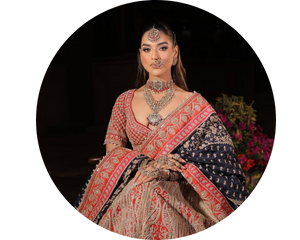
On a deep purple lehenga with choli and dupatta, like the Aasmaa, the Kirandori cord works in conjunction with Dabka Zardozi and pearl embellishments across paisley and floral motifs. The result has a richness that photographs suggest but doesn't fully capture. The cord's dimensional shimmer, the contrast of the metallic Dabka against the purple silk, and the small pearls make it mesmerising.

Shop Now: Aasmaa - Purple Lehenga With Choli And Dupatta
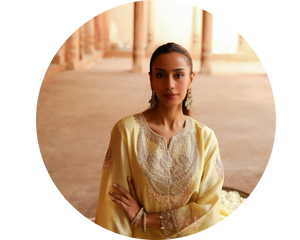
At Sheetal Batra, kirandori embroidered kurta sets on softer bases like daisy ivory, rose pink are loved by our patrons. Kirandori on softer bases exudes a softer, romantic vibe. The reflective cord against a light background creates lustre rather than drama, making these pieces as appropriate for daytime festive occasions as for evening events.
When it comes to Indian embroideries, the limelight is always on Zardozi, Chikankari or Parsi Gara. They enjoy the longest documented histories and the most dramatic visual presence. Kirandori is more understated in its origins, less codified in its tradition, and for those reasons, often overlooked in the broader conversation about Indian craft.
But Kirandori, with its mesmerising geometric patterns and vibrant motifs, carries a storytelling quality. The cord emanates light. Kirandori is unlike anything else. This heritage embroidery produces outfits of genuine beauty and genuine lasting value.
Sheetal Batra understands the need to uplift the lost heritage crafts of India. At Sheetal Batra, Kirandori embroidery is not a shortcut or a substitute for heavier techniques but a considered choice. We do not limit our artisans to kurtas and shararas - we bring bridal lehengas in exquisite kirandori work - because the embroidery is as grand and special as the bride’s lehenga on a special day. Kirandori also deserves the love other embroideries enjoy.